
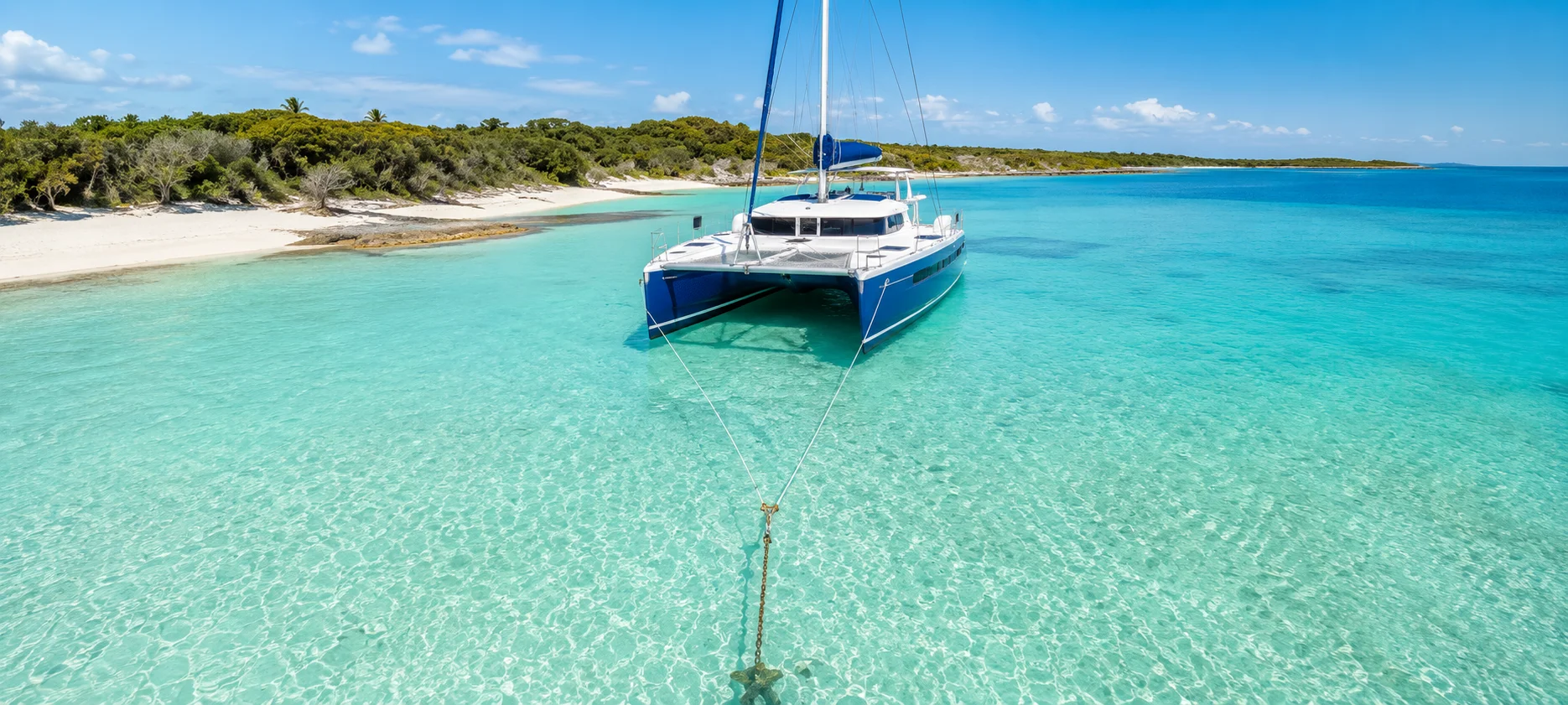
Why cats behave differently at anchor
More windage
Two hulls, a wide beam, a bridgedeck, a large cockpit and often a substantial bimini mean a catamaran catches significantly more wind than a same-length monohull. Wind load at 30 knots on a 45-foot cat can be 40 to 60 percent higher than on an equivalent monohull. Use the upper end of scope ratios, go one size up on the anchor if in doubt, and plan for the worst gust in the forecast, not the average.
No keel, no pendulum damping
A monohull with a keel behaves like a pendulum at anchor: when the wind pushes the bow off to one side, the keel acts as a restoring force that swings it back. A catamaran has no such mechanism. It hunts: it swings to one side, builds momentum, overshoots center, swings to the other side. This hunting motion puts sudden diagonal snatch loads on the anchor that can exceed the average wind load by two to three times.
Single bow attachment amplifies the problem
If you run the anchor chain straight to the bow roller of one hull, every hunting oscillation transfers as a lateral snap load to that one attachment point, and from there to the anchor. The anchor may be well set, but those repeated sideways jerks are exactly the kind of loading that eventually works it free. On a monohull, a single central bow roller keeps the load in line with the anchor. On a cat with offset attachment, it does not.
The bridle: not optional
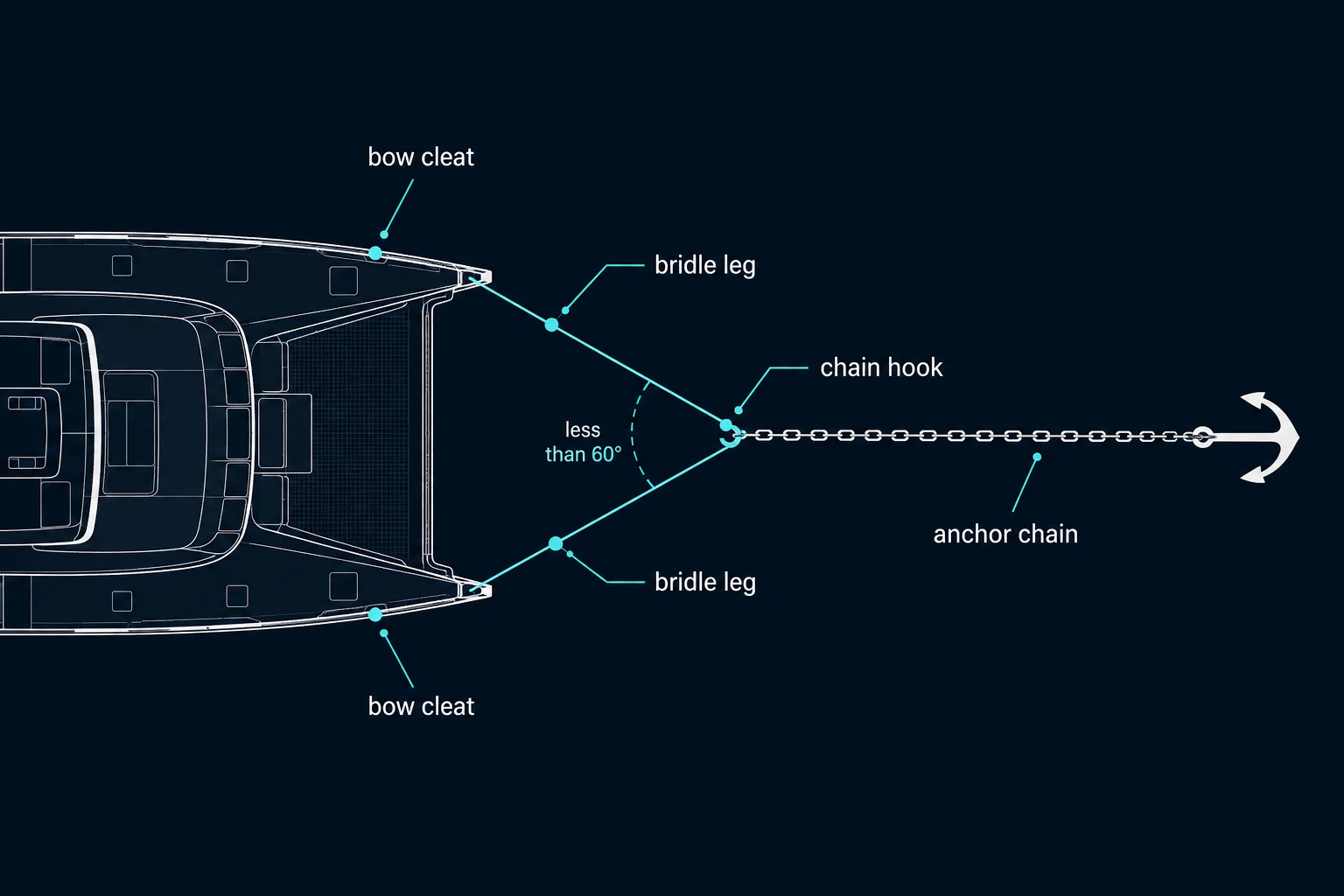
A bridle solves the hunting problem by distributing the anchor load across both bows and introducing nylon stretch into the system.
A typical bridle setup:
- Two lines of 10 to 12mm nylon, each roughly half the boat's beam plus 5 to 6m (so about 8 to 10m each on a 45-foot cat with a 7m beam).
- Each line clips from a bow cleat, runs forward and down, and meets at a central point where both are attached to the anchor chain with a snap shackle, chain hook or a pair of rolling hitches.
- With the bridle rigged, ease chain until the bridle takes the full load and the chain hangs slack between the bridle attachment point and the bow rollers.
What changes when you rig the bridle:
- The boat points steadily into wind rather than hunting across it. This alone can reduce anchor load by 30 to 40 percent on a gusty night.
- Nylon at working load stretches 15 to 20 percent. That stretch absorbs each gust as a soft deceleration rather than a hard jerk.
- Both hulls share the load. No single cleat or bow fitting takes everything.
- The chain hangs in a catenary curve below the boat, keeping the pull angle at the anchor low.
One mistake to avoid: making the bridle legs too short. If the V-angle at the chain attachment is wider than about 60 degrees, the outward component of the load starts pulling the bows apart rather than pulling the boat forward. Keep each leg long enough that the angle stays moderate.
Mooring types for cats
Standard single anchor with bridle
The default. Works well in open anchorages with consistent wind direction and enough swinging room. On a 45-foot cat at 7:1 scope in 5m depth, the swinging circle radius to the farthest corner of the boat is about 45 to 50m. That is larger than an equivalent monohull and needs to be accounted for when choosing your spot.
Bahama moor (two anchors fore and aft)
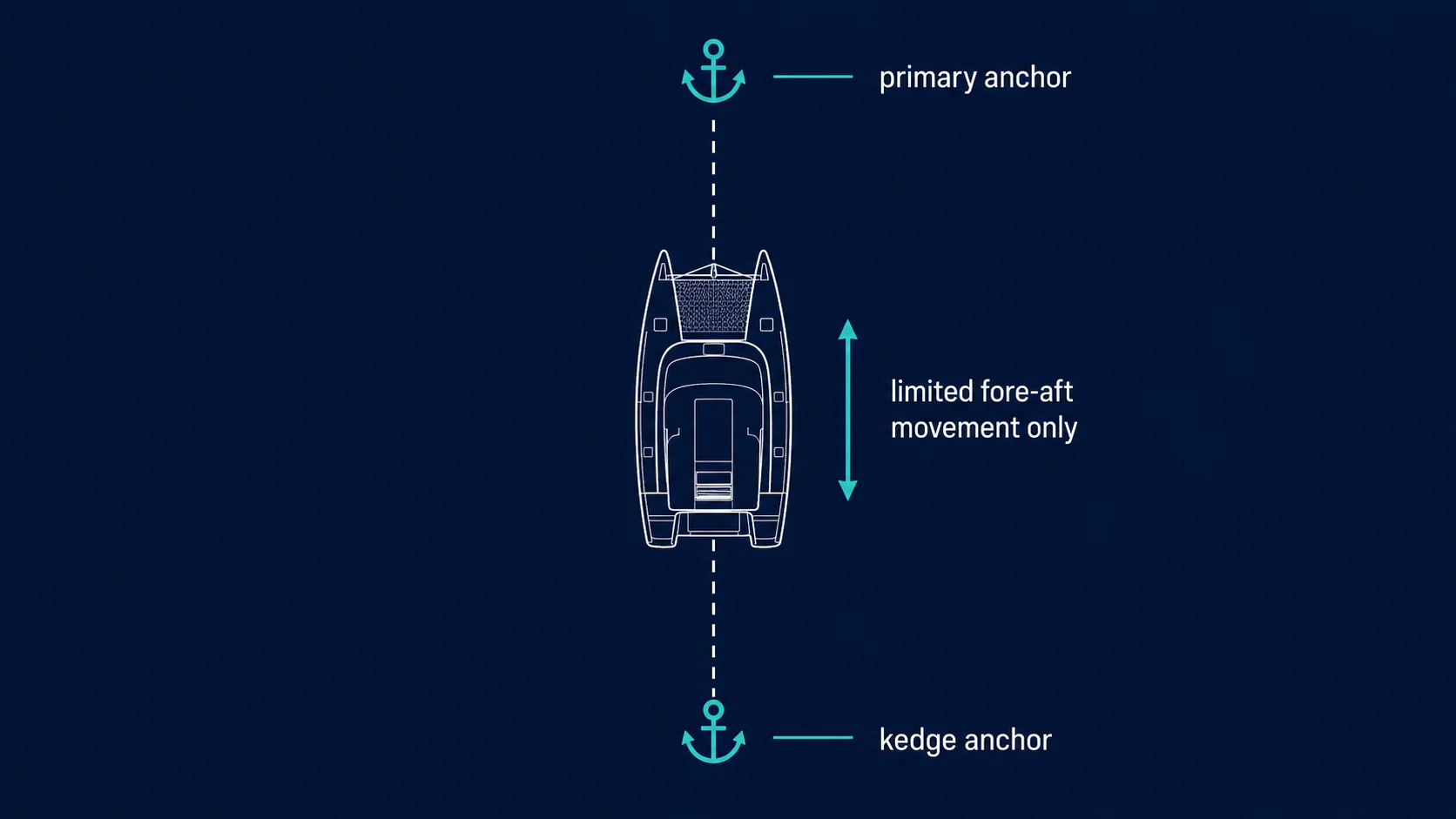
Drop the primary anchor and pay out double your planned scope. Then drop a second anchor directly behind the boat and motor forward to the midpoint between the two. The boat now sits between them on two rodes, limiting fore-aft swing to almost nothing.
Good for:
- Tight anchorages where swinging room is limited
- Anchorages where wind or current reverses with the tide overnight
- Areas with heavy boat traffic where a wide swing circle is a hazard to others
Not good for: significant wind backing or veering, where you would end up loaded at a large angle to both anchors. And it takes time to set and recover properly.
Stern lines to shore
Common in the Mediterranean, Norwegian fjords and some Caribbean anchorages where the shore is close and there are rings, trees or rocks to tie to. Drop anchor forward, back the stern toward the shore, and put two lines ashore from the stern cleats. The anchor holds the bow off; the shore lines hold the stern. The boat barely swings.
Setup on a cat: the wide beam is an advantage here. Stern lines to shore on both hulls give a very stable platform with almost no movement. Use long enough lines that they do not load at a steep upward angle to the shore attachment point.
Anchor alarm in this configuration: the effective alarm radius is very small, maybe 10 to 15m. If the anchor drags forward, the alarm fires almost immediately. If a stern line parts, the boat swings on the anchor and the alarm fires within a minute. Set it tight and trust it.
Med moor (stern-to a quay)
Drop anchor 30 to 40m from the quay, back the stern in, and put lines from both stern cleats to the quay. The quay holds the stern; the anchor holds the bow off. This is the standard mooring in most Mediterranean marinas and many anchorages. The anchor alarm is still useful: if the anchor drags, your bow swings toward the quay, and catching that early is the difference between a fender job and something worse.
GPS and anchor watch on a cat
GPS accuracy matters more on a catamaran than on a monohull because the practical alarm radius is already large (wide boat, wider swing circle). A 20m GPS wander leaves very little margin between the alarm radius and a neighboring boat. You want real accuracy, not phone-below-deck accuracy.
The phone GPS problem on cats
On a monohull, the cabin is relatively narrow and a hatch above often provides partial sky view for phone GPS. On a catamaran, the bridgedeck is wide, the cabin roof is solid fibreglass or carbon, and phone GPS through a closed bridgedeck typically sees 2 to 4 satellites instead of 10 to 12. Position wanders 15 to 30m with the boat stationary. That is not good enough for a tight alarm radius in a Med anchorage.
Garmin GLO 2 (~$119): the simple fix
Place the GLO 2 in the bridgedeck net, clip it to a safety line forward, or sit it on the bridgedeck in any position with open sky. Run a USB cable below. Pair via Bluetooth. The GLO 2 uses both GPS and GLONASS, giving it access to more satellites and better geometry than a GPS-only receiver. Typical accuracy with a clear sky view: 2 to 5m.
Compare that to a phone inside the bridgedeck cabin: 15 to 30m typical. At 5m accuracy you can set a 25m alarm radius and be confident. At 25m accuracy you need a 60m radius, which on a cat in a Med anchorage may include the boats either side of you. The $119 hardware difference buys a fundamentally more useful anchor watch.
The GLO 2 draws almost no power. Plugged into a USB port on the nav table, it runs indefinitely without affecting the phone battery. Once paired, you forget it is there.
NMEA from the chartplotter
If your plotter broadcasts NMEA 0183 position over the boat's WiFi, point Anchor Alarm Pro at the network GPS source directly. The boat's GPS antenna is typically mounted on a deck arch or radar mast with a permanently clear sky view, and the fix it produces is consistently 2 to 4m. This is often the best possible source on a cat, because the antenna location is ideal and there is no Bluetooth involved.
Setting the alarm radius on a cat
The right alarm radius on a catamaran is larger than on a monohull anchored in the same spot. The calculation:
- Take the scope you have out (say 35m at 7:1 in 5m)
- Add half your beam width (a 7m beam adds 3.5m to the radius of the swinging circle)
- Add a buffer for normal GPS accuracy (5m with a GLO 2, 20m with phone GPS)
For this example: 35 + 3.5 + 5 = roughly 44m radius. Set 50m and accept that occasional arcing near the boundary will not trigger a false alarm.
In a Bahama moor or stern-to configuration, the actual movement is much smaller and you can set a much tighter radius: 15 to 20m is reasonable and will catch a drag quickly.
Corridor mode for Bahama moors and stern-to
Anchor Alarm Pro includes a corridor zone mode designed for situations where you are constrained fore-aft rather than swinging freely in a circle. Set the corridor width to match your expected movement and the app tracks it accurately. Free to use, no account needed.
The overnight checklist for cats
- Choose a spot with extra swinging room: other boats will swing closer to you than they expect, because your circle is wider.
- Drop anchor and pay out scope: go to the upper end of the ratio (7:1) given the higher windage.
- Power-set: same technique as a monohull, but check that the boat is tracking straight back, not sheering. If the cat is sheering badly when you reverse, the anchor may set at an angle; haul up and try again.
- Rig the bridle before dinner. 10 minutes now saves a restless night.
- Place the GLO 2 with sky view, confirm Anchor Alarm Pro is reading it.
- Set alarm radius (account for beam width), plug the phone in, enable notifications.
- Check the track after 20 minutes before going below.
This is general seamanship information, not a substitute for your own judgement, local knowledge and a proper lookout. Catamaran handling varies significantly between designs.