
Step 1: Check the forecast before you arrive
The most important thing you check is not the current wind. It is what the wind will be doing at 0200 and 0600. A bay that is perfectly sheltered from the southwest afternoon seabreeze may be completely open to the north if the wind backs overnight. A forecast that shows 12 knots at 1800 and 28 knots by 0300 is not a calm night: it is a night that catches you out if you set scope for the 12.
What to look for:
- Wind direction shift: does your chosen anchorage stay sheltered through all forecast directions?
- Gust strength overnight: set scope for the highest gust, not the average.
- Tidal range: if the tide rises 1.5m overnight, your effective scope ratio drops unless you added that to the calculation. At 3:1 in 5m depth, a 1.5m tide rise makes you effectively 3:1 in 6.5m: now you need more chain out.
Check two sources if the night matters. Windy and a local coastal forecast rarely agree exactly, and the difference between them is where the uncertainty lies.
Step 2: Choose the spot carefully
Pick shelter from the forecast wind direction, not the current one. Then imagine the full swinging circle your boat will trace as the wind shifts overnight. Does every part of that circle clear nearby boats, shallows, rocks and the shore at low tide? Other boats swing too, and they may not swing at the same rate as you if they have different rode types or lengths.
Look at the seabed type on the chart. Sand and firm mud are good. Weed, kelp and rock are unreliable (see our piece on why anchors drag for the detail). If you can see the bottom in clear water, a look over the side while motoring slowly over the spot tells you everything. In a new anchorage, watch where existing boats are swinging: boats on all-chain scope shorter and swing less than boats on rope-and-chain.
Check your exit. If it blows up at 0300, can you motor out safely in the dark?
Step 3: The drop
- Motor slowly over the spot, watching the depth sounder for any variation from the charted depth.
- Head into the wind or current, whichever is stronger. Come to a stop.
- Lower the anchor from the bow roller under control. Do not throw it: throwing piles the chain on top of the anchor and prevents it from setting.
- Let the boat drift back naturally while you pay out rode at a steady rate. The chain should lay out in a line behind the boat, not pile up below the bow.
- When the planned scope is out, snub the chain gently on the windlass and feel the load come on.
Step 4: Set the scope for overnight
Scope is the ratio of rode paid out to the depth measured from the bow roller (add tidal range for overnight stays).
- All-chain, calm forecast: 5:1 minimum, 6:1 comfortable.
- All-chain, wind expected or gusty: 7:1 or more.
- Chain-and-rope: 7:1 minimum overnight, more in any wind.
In a crowded anchorage where 7:1 would put you on a neighbor: go to 5:1 and compensate by going one size up on the anchor if possible, or accept that you will wake up occasionally to check. Short scope in a crowded anchorage is a judgment call, not a recommendation.
Step 5: Power-set
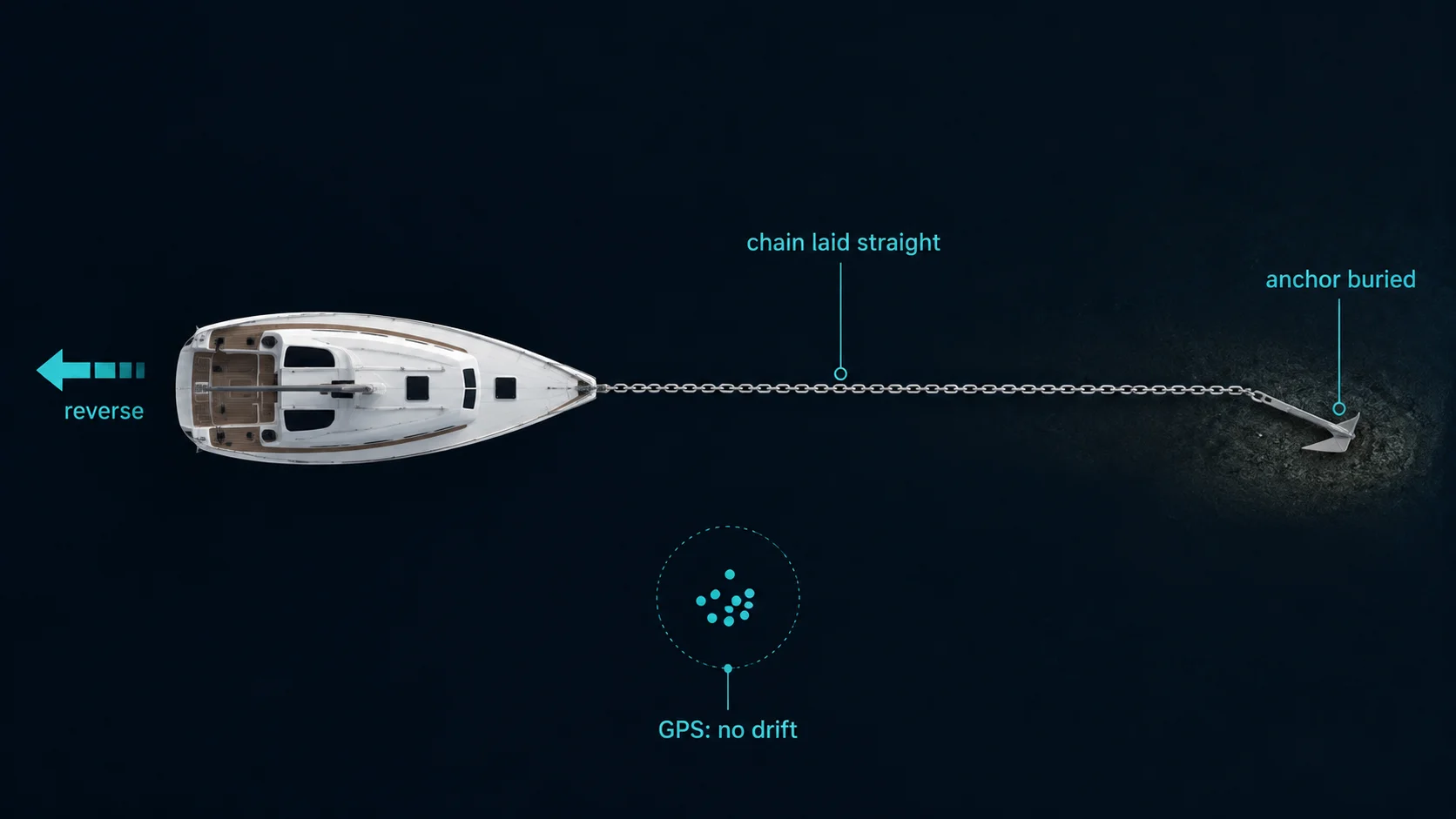
With scope out, put the engine in reverse and build to about 1500 rpm over 20 to 30 seconds. Watch a fixed point on shore and the GPS simultaneously. You want zero movement while the engine is loading the anchor. Hold that for 30 seconds.
If you are still slowly creeping backward, the anchor is dragging: haul up and try again. This is not optional. A properly set anchor in decent ground will hold the boat against full astern: the engine loses before the anchor does. A poorly set anchor will drag tonight.
Step 6: Rig the snubber
A snubber is a 5 to 8m length of nylon line (10 to 14mm) attached to the chain with a chain hook or rolling hitch, led to a bow cleat. Once rigged, ease enough chain that the snubber takes all the load and the chain hangs slack between the snubber attachment and the bow roller.
What a snubber does: nylon stretches 15 to 20 percent under load, absorbing the shock of gusts and waves that would otherwise transmit directly to the anchor as sharp jerks. Those jerks are what break out a well-set anchor. The snubber also silences the chain groan against the bow roller, which means you actually sleep. The windlass takes zero overnight load.
Step 7: The first 20 minutes
Do not go below for dinner until you have watched the boat for 20 minutes and checked the GPS track. A well-set anchor shows the boat hovering in a small cluster of points, barely moving. A dragging anchor shows a slow, continuous movement in one direction.
This is the check most people skip and the most valuable one to do. If you are drifting at all, you are dragging, and the time to deal with it is now, not at 2300.
Step 8: Set up the anchor watch
With the boat settled, open Anchor Alarm Pro:
- Set the anchor position: tap the anchor button. The app marks your current GPS position as the anchor point.
- Set the alarm radius: use approximately your scope distance plus one boat length plus a buffer. Err on the generous side. A 30m radius in a 5m-deep anchorage at 7:1 scope (35m of chain) is reasonable. A 20m radius will produce false alarms from normal GPS wander.
- Enable notifications: go to your phone settings and confirm Anchor Alarm Pro can send you alerts with the screen off. This is what wakes you up.
- Test the alarm: the app lets you simulate a drag, or you can walk back toward your alarm radius boundary to confirm the alarm fires.
- Plug the phone in: GPS running all night drains a phone in 4 to 6 hours without charging. A dead phone at 0300 means no anchor watch for the rest of the night.
Why phone GPS often fails below deck
A phone's GPS antenna is a tiny chip optimised for outdoor use. In a cabin below the waterline, surrounded by fibreglass, the phone may only see 2 to 4 satellites instead of the 8 to 12 available above deck. The position it reports wanders 20 to 50m even when the boat is stationary. That wander triggers the alarm and trains you to ignore it, which is the worst possible outcome.
The fix: give the GPS a clear sky view.
External GPS: the clean solution
"I put a Garmin GLO 2 on the nav table, plugged it into USB, and paired it once. It has not moved since. The phone barely uses any battery because the GPS work is being done 2m away on a unit that never goes flat."
Garmin GLO 2 (~$119): place it on the nav table, on a shelf near a hatch, or anywhere with partial sky view. Plug into any USB port. Pair via Bluetooth. It uses both GPS and GLONASS satellite constellations, giving it access to more satellites than GPS-only receivers. In open sky, typical accuracy is 2 to 5m. Below deck near a hatch, still usually 3 to 8m. Compare that to a phone in a closed aft cabin at 20 to 50m. Once paired and selected as a GPS source in Anchor Alarm Pro, the app uses the GLO 2 fix and falls back to phone GPS automatically if Bluetooth drops overnight.
With a 3 to 5m GPS accuracy, you can set a 20m alarm radius and trust it. At 30m phone GPS wander you need a 60m radius to stop false alarms, which may overlap with a neighboring boat before the alarm fires. The $119 difference in hardware buys you a fundamentally more useful anchor watch.
NMEA from your chartplotter: most modern Garmin, B&G, Raymarine and Furuno plotters broadcast NMEA 0183 position over the boat's WiFi network, either directly or via a WiFi gateway. This uses the boat's own GPS antenna, which typically has a permanently clear sky view from a deck or masthead mount. Enter the IP address and port in Anchor Alarm Pro's GPS settings. Auto mode then blends this with any other active source.
Signal K: if you run a Signal K server (Victron Cerbo GX, OpenPlotter or a Raspberry Pi), Anchor Alarm Pro connects to it by URL and reads whatever position your boat instruments are feeding.
The before-bed checklist
- Re-check the forecast: any change to overnight shift or gust strength since you anchored?
- Scan the anchorage: any boat that has swung closer since you arrived? Anyone who anchored too close after you?
- GPS track so far: tight cluster (good set) or slow drift (not good)?
- Anchor alarm: armed, correct position, radius sensible?
- Alarm volume: loud enough to wake you through a closed door?
- Phone: plugged in and charging?
- Snubber taking the load, windlass free?
In the morning
Check the overnight track in the app before you haul anchor. A good night shows gentle arcs centered on the anchor point: the boat swung as the wind shifted but always came back to the same circle. A straight-line excursion that reversed is a drag that re-set: worth knowing about, because it tells you the set was marginal or the scope was close to the limit.
If the track shows a slow, consistent drift that stabilised in a different position, the anchor dragged and re-buried somewhere else. Note the distance and direction for future reference about that anchorage and seabed.
Free anchor watch, runs in the background
Anchor Alarm Pro connects to phone GPS, Bluetooth receivers and NMEA simultaneously. Auto mode uses the most accurate live source and falls back instantly if one drops. Set the alarm before you sleep and the app watches all night, whether the screen is on or off. No account, no subscription.
This is general seamanship guidance, not a substitute for your own judgement, a proper lookout and awareness of local conditions. Every anchorage and boat is different.