

The mechanics of holding power
An anchor holds by burying itself in the seabed and resisting a horizontal pull. Two things keep that pull horizontal: the weight of the chain forming a catenary curve, and a long enough scope so the angle of the rode at the anchor stays low. When either of those conditions fails, the anchor shank lifts, the flukes rotate out of the seabed, and the anchor trips.
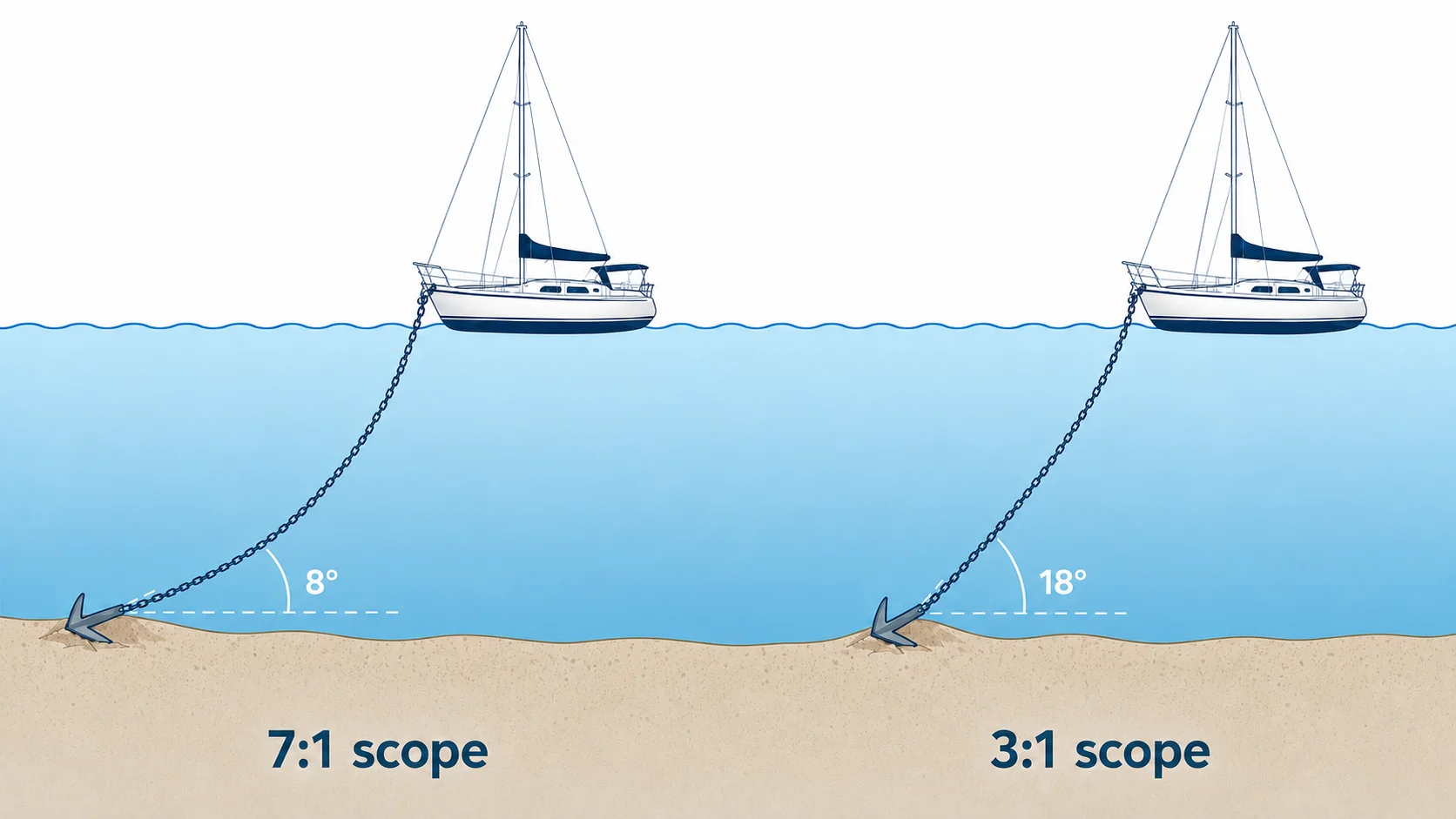
The numbers are instructive. Suppose you are anchored in 5m with 1m of freeboard: the rode runs from 6m above the seabed. At 7:1 scope you have 42m of rode out, giving a pull angle of arctan(6/42) = 8 degrees. Very nearly horizontal. At 3:1 you have 18m out: arctan(6/18) = 18 degrees. The shank is already starting to lift. A gust that takes the load up sharply can easily push that angle past 25 degrees and break the anchor out.
Wind load and the squared relationship
Wind force on a boat scales with the square of wind speed. This is the relationship that surprises people most. A boat that sits comfortably at anchor at 20 knots feels four times the force at 40 knots, not twice. The anchor and rode that held easily through the afternoon may be close to their limit by midnight when the wind has doubled.
Approximate wind load on a 40-foot monohull in open water:
- 15 knots: 200 to 300 kg load on the anchor
- 25 knots: 500 to 700 kg
- 35 knots: 1000 to 1400 kg
- 40 knots: 1400 to 2000 kg
These numbers vary with mast height, dodger size, bimini and coach roof profile. A cat or a high-sided motorsailer will be considerably higher. The key insight: what held at 20 knots may not hold at 30. Plan your scope for the worst gust forecast, not the average.
Holding power by seabed type
A well-set modern scoop anchor (Rocna, Spade, Mantus) in firm sand can develop holding force of 8 to 12 times its own weight. The same anchor in different ground:
- Firm sand: 8 to 12x anchor weight. Most anchors excel here.
- Soft mud: 4 to 8x. Deep penetration helps, but the soil offers less resistance per unit of area.
- Weed, kelp and posidonia grass: 0 to 2x. The anchor skates across the top of the mat, rarely breaking through to the sand below. This is the most dangerous bottom for dragging.
- Rock and coral: 1 to 3x, almost entirely from snagging rather than burying. A snagged anchor can hold well until it dislodges suddenly with no warning.
- Hard clay: 3 to 6x. Anchors can take a long time to set in hard clay and may not bite at all if the tip cannot penetrate the crust.
The four causes, with real examples
1. Scope too short
The most common cause. It rarely causes immediate dragging in calm conditions, which is exactly why it goes unchallenged until conditions worsen.
Scenario: calm evening anchorage, anchor set at 5:1 in 4m. Wind comes up overnight to 28 knots. The boat surges back on each gust. The chain straightens, the pull angle rises above 20 degrees, the shank lifts, and the anchor rotates and skips backward 30m before re-setting in a different orientation. The GPS track shows the excursion starting very gradually over about 8 minutes: slow at first, then accelerating as the anchor sheds more sand with each surge. An anchor alarm set at a 30m radius catches it in the first 3 to 4 minutes.
The fix: use genuine scope. 5:1 minimum for calm overnight conditions with all-chain; 7:1 or more if any wind is expected, or if using rope-and-chain. Measure from the bow roller to the seabed, and add the expected tidal rise.
2. The anchor never properly set
An anchor that looks set is not always set. If the boat was not backed down firmly, or if the anchor landed on debris or a patch of weed, it may be sitting on the surface rather than buried in it.
Scenario: the boat drifts back onto a patch of kelp. The anchor lands on the mat, the crew watches the chain, sees it come taut, and assumes they are set. Light air through the evening and the boat holds fine. At 2300 the seabreeze fills in at 18 knots: the anchor lifts off the weed and the boat is 60m from the original position before the first person wakes up. The GPS track shows a gradual but continuous drift for about 25 minutes before the alarm would have been set off.
The fix: power set every time. Apply engine thrust astern, build to about 1500 rpm over 30 seconds, and confirm with a fixed bearing or the GPS that the boat is truly stationary while under load. If you are still moving, haul up and try again. A properly set anchor in good ground will hold the boat against full astern: the engine will lose before the anchor does.
3. Wind shift breaks the anchor out
This is the cause of more middle-of-the-night emergencies than any other, because it can happen to an anchor that was perfectly set and has held all evening.
Scenario: anchored at 2100, anchor set firmly in sand, boat pointing northwest into the evening breeze. Wind clocks 150 degrees to the northeast by 0300. The boat swings around. Now the anchor is being loaded from a direction it has never been loaded from. Most CQR and Delta plows do not reset from a side load: they tip onto their side and begin to skip through the sand. New-generation scoop anchors (Rocna, Spade, Mantus) have a roll bar or ballasted tip designed to let them right themselves and reset, and they usually do. But no anchor resets every time from every angle. A GPS track that starts showing a slow arc away from centre is the signal: the anchor broke out during the swing and has not re-buried.
The fix: choose anchorages with shelter from all forecast wind directions, not just the current one. Check what the wind is doing at 0200 and 0600. If a shift is forecast, either use a Bahama moor (two anchors set 180 degrees apart to limit swing), or set generous scope and accept that you may need to re-anchor if the anchor drags in the new direction. An anchor watch tells you immediately if the swing produces a genuine drag rather than just normal arc movement.
4. Chain piling on the anchor in shallow water
This one is counterintuitive and catches sailors who know about scope but anchor in very shallow water.
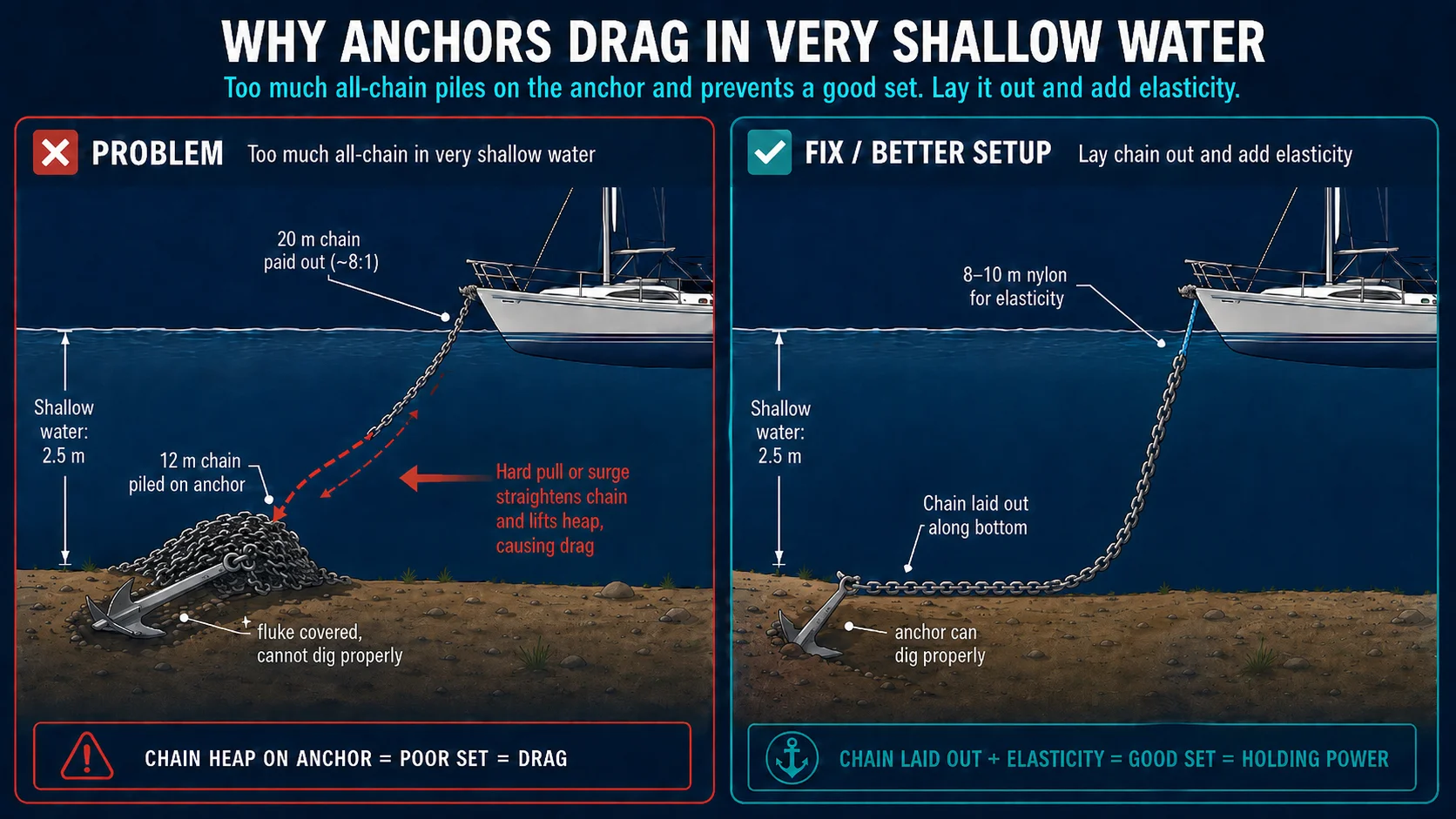
Scenario: anchored in 2.5m with all-chain. 20m of chain paid out, which is nearly 8:1 and looks excellent. But the boat barely had room to drift back before the chain came taut. The result: 12m of chain is lying in a heap directly on top of the anchor. The chain weight is pressing down on the shank and covering the fluke, preventing the anchor from digging in properly. Any hard surge snaps the chain straight, lifts the heap, and the anchor has no seabed resistance. The boat can drag on what looks like a perfectly generous scope.
The fix: in very shallow water, less chain sometimes works better than more. If depth is under 3m and you are on all-chain, consider using 8 to 10m of nylon rope between chain and windlass to give the system some elasticity and ensure the chain lies out along the bottom rather than piling up. Alternatively, motor back slowly after dropping to lay the chain out in a line.
A drag that starts small stays manageable
The GPS track of a dragging anchor has a characteristic shape: a slow, continuous movement in one direction that gradually accelerates as the anchor loses more contact with the seabed. Anchor Alarm Pro watches that GPS track continuously and sounds a loud alarm the moment the boat leaves the safe circle, usually within 2 to 4 minutes of the drag starting. That window is the difference between starting the engine and motoring back to position, and waking up on a lee shore. Set it before you sleep. It is free, needs no account, and works in the background with the screen off.
The pattern underlying all four
Every drag scenario has the same structure: a condition that looked adequate at anchor time stopped being adequate when conditions changed. The wind came up, shifted, or the seabed turned out to be different than expected. The anchor was the last component of a system to be stress-tested, and it failed that test.
The practical response is not paranoia but preparation: set scope for the worst expected conditions, not the average. Power-set every time and confirm with the GPS. Check the seabed type before you drop. And keep a watch running while you sleep, so a drag that starts at 4m a minute does not become a 200m problem by the time you wake up.
These are general seamanship notes, not a substitute for your own judgement, local knowledge and a proper watch. Conditions and seabeds vary enormously.